Last Verified: 28 July 2026 — every fee figure below was re-checked against the Punjab Excise, Taxation & Narcotics Control Department’s official published service-fee schedule immediately before this article went live. No newer official notification revising these amounts could be located at the time of verification. Please verify the latest applicable fee from the Punjab Excise, Taxation & Narcotics Control Department, as charges may change.
If you have just bought or sold a car or bike in Punjab, the paperwork is not finished until the ownership transfer is done. A vehicle sitting on the seller’s name after money has changed hands is one of the most common (and most expensive) mistakes people make in Punjab’s used-vehicle market. It leaves the seller responsible for challans, accidents, and token tax on a vehicle they no longer own, and it leaves the buyer without a legally recognised title.
This guide covers the complete Punjab Vehicle Transfer Fee 2026 structure, the documents you need, the step-by-step process at your district Excise office, and the online payment option through ePay Punjab. Every fee figure here is cross-checked against the Punjab Excise, Taxation and Narcotics Control Department’s own published service-fee schedule, not guessed or copied from unverified blogs. Where official figures could not be confirmed with certainty, we say so directly and point you to where to verify them.
Executive Summary
In short: transferring a motorcycle in Punjab costs PKR 150 as a base transfer fee, while cars are charged PKR 1,200 to PKR 3,000 depending on engine capacity, according to the Excise & Taxation Department’s published service-fee schedule. On top of that, budget PKR 530 for the Smart Registration Card and PKR 300 for the Transfer Deed (T.O. Form); no separate biometric-verification fee is listed in the official schedule we verified, so please verify the latest applicable fee from the Punjab Excise, Taxation & Narcotics Control Department if your district office charges one. Both buyer and seller must appear in person for biometric verification, current-year token tax must be cleared first, and the whole process — done correctly — typically takes a few weeks from application to a new smart card in the buyer’s name.
This article also flags something important: several websites are currently claiming that Punjab has launched a “2026 relief scheme” waiving transfer fees entirely. We could not verify this claim against any official Excise Department notification, so we are not repeating it as fact. Treat it as unconfirmed until you see it on an official government channel.
What is Vehicle Ownership Transfer?
Vehicle ownership transfer is the legal process of updating a car or bike’s registration record with the Excise & Taxation Department so it reflects the new owner’s name, CNIC, and address. In Punjab, every registered motor vehicle has a Smart Card (and, before that, a registration book) that names the legal owner. When a vehicle is sold, gifted, or inherited, that record has to be updated — otherwise, as far as the government is concerned, the original person named on the card is still the legal owner, regardless of who actually has the keys.
This matters more than most buyers realise. Token tax notices, traffic challans, and even court notices related to accidents are issued to whoever’s name is on the registration record. If that is still the seller, they inherit legal and financial headaches for a vehicle they no longer own.
Who Needs Ownership Transfer?
Anyone who buys, sells, inherits, or receives a registered motor vehicle as a gift in Punjab needs to complete an ownership transfer with the Excise & Taxation Department. This applies whether the vehicle is a motorcycle, a private car, a commercial vehicle, or a heavy transport vehicle (HTV). It also applies to:
- Private buyers and sellers completing a used-vehicle sale
- Families transferring a vehicle after inheritance (legal heirs)
- Individuals receiving a vehicle as a gift from a relative
- Businesses buying or selling vehicles registered under a company name
- Banks or leasing companies transferring ownership after a completed lease
The one group that does not need a standard transfer is someone buying a brand-new, never-registered vehicle directly from a dealer — that goes through new registration instead, which is a separate process with its own fee structure.
When Should You Transfer Ownership?
Ideally, ownership transfer should be initiated within a few days of completing a vehicle sale, and always before the next token tax due date. There is no single province-wide “grace period” published for private-to-private ownership transfer the way there is for new registration (which does carry a late fee after 30–180 days). But practically speaking, delaying transfer creates three real problems:
- The seller remains legally responsible for challans and token tax until the transfer is recorded.
- The buyer cannot use the vehicle smart card in their own name for verification purposes, which complicates resale, insurance claims, or bank financing.
- Tracking down the seller for signatures and biometric verification only gets harder the longer you wait — people change phone numbers, move cities, or become unreachable.
Our practical recommendation: complete the transfer within 30 days of the sale, while both parties are still easy to reach and the paperwork is fresh.
Latest Punjab Vehicle Transfer Fee 2026
The figures below come from the Punjab Excise & Taxation Department’s official district service-fee schedule, which lists “Rates of Transfer Fee” as a distinct line item separate from token tax, luxury tax, and new-registration fees — three categories that unrelated blogs frequently confuse with the transfer fee, producing wildly inflated numbers online. We deliberately avoided repeating those inflated figures here.
Base transfer fees in Punjab have historically stayed fairly stable compared with token tax, which is revised more often. That said, the Excise Department can revise any fee by notification at any time, and the source document for these figures does not itself carry an explicit “effective as of” date for the transfer-fee table. So treat the table below as the officially published baseline rather than a guaranteed current-day number. Please verify the latest applicable fee from the Punjab Excise, Taxation & Narcotics Control Department, as charges may change, and always confirm the exact challan amount through ePay Punjab or your district Excise office before paying.
Complete Fee Table
| Fee Component | Amount (PKR) |
|---|---|
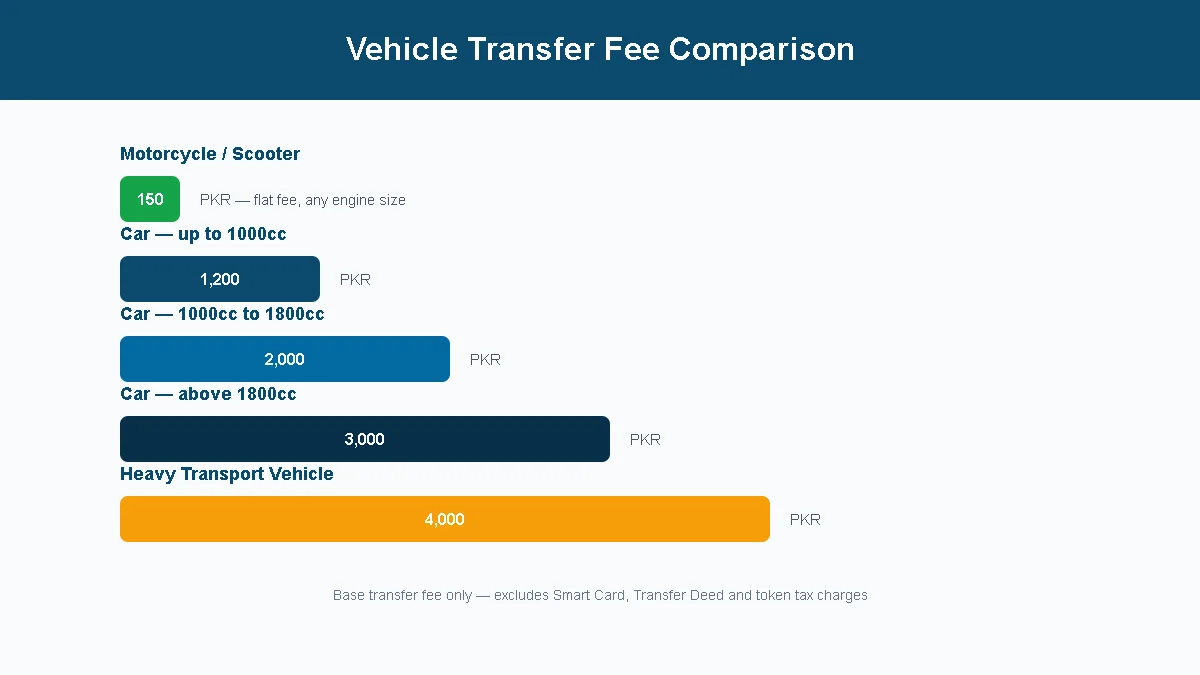
| Motorcycle/scooter transfer fee | 150 |
| Car transfer fee — up to 1000cc | 1,200 |
| Car transfer fee — 1000cc to 1800cc | 2,000 |
| Car transfer fee — above 1800cc | 3,000 |
| Heavy Transport Vehicle (HTV) transfer fee | 4,000 |
| Smart Registration Card | 530 |
| T.O. Form (Transfer Deed) | 300 |
| Biometric verification | Not listed as a separate official charge — please verify the latest applicable fee from the Punjab Excise, Taxation & Narcotics Control Department, as charges may change |
These amounts are added together on your challan, along with any pending token tax for the current year, which must be cleared before the transfer can be finalised.
Bike Transfer Fee
Motorcycle and scooter ownership transfer in Punjab carries a flat transfer fee of PKR 150, regardless of engine capacity — a 70cc bike and a 150cc bike pay the same base transfer fee. On top of that flat fee, you will still need to pay for the Smart Registration Card (PKR 530) and the Transfer Deed (PKR 300), plus any outstanding token tax. For a typical bike transfer with no pending dues, that puts the combined officially-listed charges at roughly PKR 980, though this does not include any locally-applied biometric or processing charges that were not listed as a separate line item in the published fee schedule we verified — please verify the latest applicable fee from the Punjab Excise, Taxation & Narcotics Control Department, as charges may change, and always confirm the exact total on your printed challan. If you haven’t already, it’s worth doing a bike verification check before you finalise a purchase, so you know the vehicle’s registration status before you start the transfer paperwork.
Car Transfer Fee
Car transfer fees in Punjab scale with engine capacity: PKR 1,200 for cars up to 1000cc, PKR 2,000 for cars between 1000cc and 1800cc, and PKR 3,000 for cars above 1800cc. This is the base government transfer fee only — it does not include the Smart Card fee, Transfer Deed, biometric charge, or any pending token tax, all of which are billed on the same challan. A mid-size 1300cc sedan, for example, falls in the 1000–1800cc bracket and is charged PKR 2,000 in base transfer fee, plus the standard smart card and deed charges on top.
Transfer Fee by Engine Capacity
| Engine Capacity | Vehicle Type | Transfer Fee (PKR) |
|---|---|---|
| Any capacity | Motorcycle/Scooter | 150 |
| Up to 1000cc | Car | 1,200 |
| 1001cc–1800cc | Car | 2,000 |
| Above 1800cc | Car | 3,000 |
| N/A | Heavy Transport Vehicle | 4,000 |
Smart Card Charges
The Smart Registration Card fee is PKR 530, as listed under the Excise Department’s own “Security Feature Items” fee schedule. A few independent, non-official sources cite higher figures (up to around PKR 630); we could not corroborate those against any official document, so we are publishing the confirmed official figure only. Please verify the latest applicable fee from the Punjab Excise, Taxation & Narcotics Control Department, as charges may change. Every successful ownership transfer results in a brand-new Smart Card issued in the buyer’s name — the old card in the seller’s name is retired. If you ever need to double-check a vehicle’s current registered owner after a transfer, MTMIS Punjab’s vehicle verification tools let you look up basic registration status online.
Required Documents
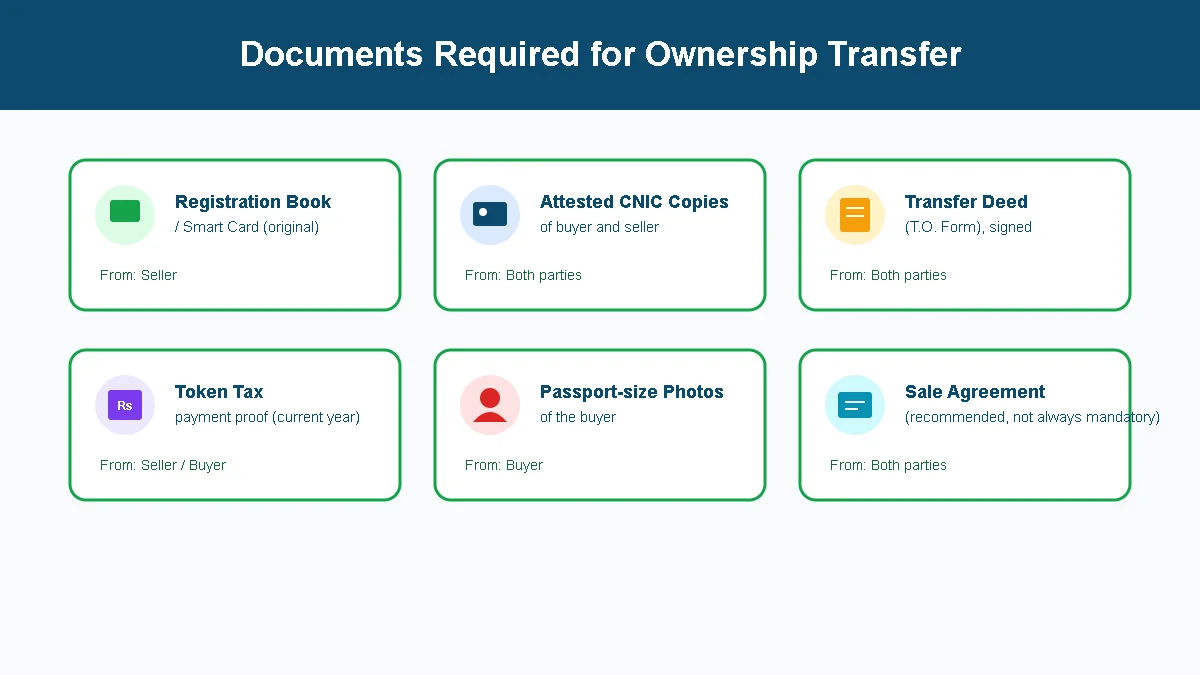
You will need the vehicle’s original registration book or Smart Card, attested CNIC copies of both buyer and seller, a completed Transfer Deed (T.O. Form), and proof that current-year token tax has been paid. Both parties also need to be physically present (or represented by a valid power of attorney) for biometric verification.
Required Documents Table
| Document | Required From | Notes |
|---|---|---|
| Original Registration Book / Smart Card | Seller | Original, not a photocopy |
| Attested CNIC copy | Buyer | Original CNIC also carried for biometric matching |
| Attested CNIC copy | Seller | Original CNIC also carried for biometric matching |
| Transfer Deed (T.O. Form) | Both | Signed by both buyer and seller |
| Token tax payment proof | Seller/Buyer | Current year’s tax must be cleared first |
| Passport-size photographs | Buyer | Some districts require 1–2 photos for the file |
| Sale agreement/receipt (recommended) | Both | Not always mandatory, but useful proof of the transaction date and price |
Eligibility Requirements
To transfer a vehicle in Punjab, both buyer and seller must hold valid CNICs, the vehicle must have no unresolved legal disputes or outstanding stolen-vehicle flags, and current-year token tax must be clear. A few situations add extra steps:
- If the seller is unavailable, a registered power of attorney is required instead of in-person biometric verification.
- If the vehicle is inherited, a succession certificate or equivalent legal heir documentation is needed alongside the CNICs of all legal heirs (or their authorised representative).
- If the vehicle was financed through a bank or leasing company, a “no objection certificate” (NOC) from the financier is required before transfer, since the bank is often the registered owner or lien-holder until the loan is fully paid.
- Commercial and HTV vehicles may require additional fitness or route-permit documentation depending on the vehicle category.
Step-by-Step Ownership Transfer Process
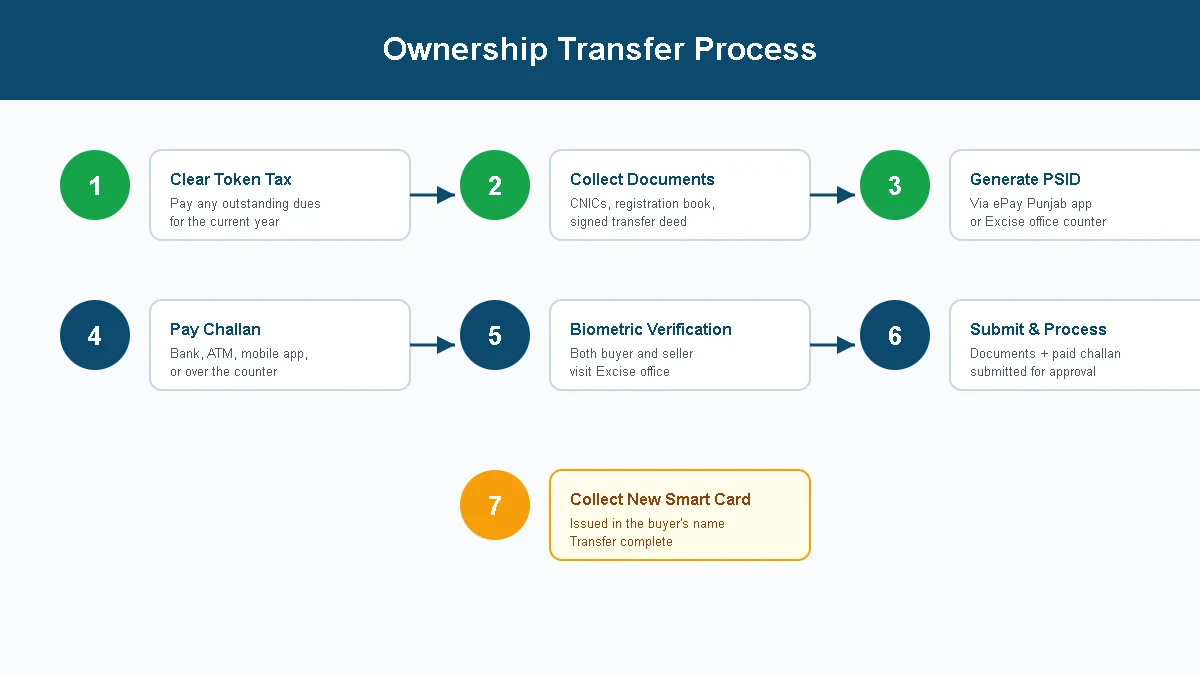
The Punjab vehicle transfer process involves clearing token tax, generating a challan, visiting the Excise office for biometric verification, and collecting the new Smart Card once approved. Here is the full sequence:
- Confirm the vehicle’s registration status and outstanding dues using the Excise Department’s online vehicle verification tool or MTMIS Punjab’s vehicle check.
- Clear any outstanding token tax for the current year, since transfer applications are not processed against unpaid tax.
- Collect the required documents from both buyer and seller: original registration book/Smart Card, attested CNIC copies, and a signed Transfer Deed (T.O. Form).
- Generate a PSID (Payment Slip ID) for the transfer fee, either through the ePay Punjab app/portal or at the Excise office counter.
- Pay the challan amount through a partner bank, ATM, mobile banking app, or over the counter.
- Visit the district Excise & Taxation office with both parties present for biometric verification (fingerprint and photograph).
- Submit the paid challan and documents to the transfer counter for processing.
- Wait for processing and approval; you will typically be notified when the new Smart Card is ready for collection.
- Collect the new Smart Card, now issued in the buyer’s name, completing the legal transfer.
Offline Process
The traditional offline route means visiting your district Excise & Taxation office in person with both buyer and seller, submitting physical documents at the counter, paying the challan there (or bringing a paid challan), and completing biometric verification on-site. This remains the only option for older registration-book vehicles that haven’t yet been upgraded to a Smart Card, and it is generally the more reliable route if either party is not comfortable with digital payments or app-based verification. The trade-off is time: counter processing can mean queues, multiple visits if any document is missing, and dependence on office hours.
Online Services (if available)
Punjab’s Excise Department, through PITB, has enabled online fee payment for vehicle transfer via the ePay Punjab app and portal. You can generate a PSID for the transfer fee, token tax, and any hire-purchase-agreement charges, then pay through internet banking, mobile wallets, ATMs, or over-the-counter banking — without standing in line at the Excise office purely to pay. It’s worth noting this online capability currently covers fee payment, not the entire transfer process end-to-end; biometric verification of both parties still needs to happen in person at the Excise office, since Punjab’s transfer system is built around physical biometric confirmation to prevent fraudulent transfers. Think of ePay Punjab as removing the payment queue, not the verification visit.
Transfer Processing Time
Most sources and district offices report a typical processing window of roughly two to four weeks from submission to a new Smart Card being ready, though this is not a figure we found published as an official service-level guarantee, so treat it as a general expectation rather than a fixed deadline. Processing time can be affected by document completeness, whether biometric verification succeeds on the first visit, and the workload at your specific district office.
| Stage | Typical Timeframe |
|---|---|
| Document collection and challan generation | Same day, if documents are ready |
| Challan payment (online or bank) | Same day to 1–2 business days |
| Biometric verification at Excise office | Same-day appointment, subject to office queue |
| Application processing and approval | Commonly reported as 2–4 weeks |
| New Smart Card issuance/collection | Notified after approval; collect at district office |
Common Mistakes to Avoid
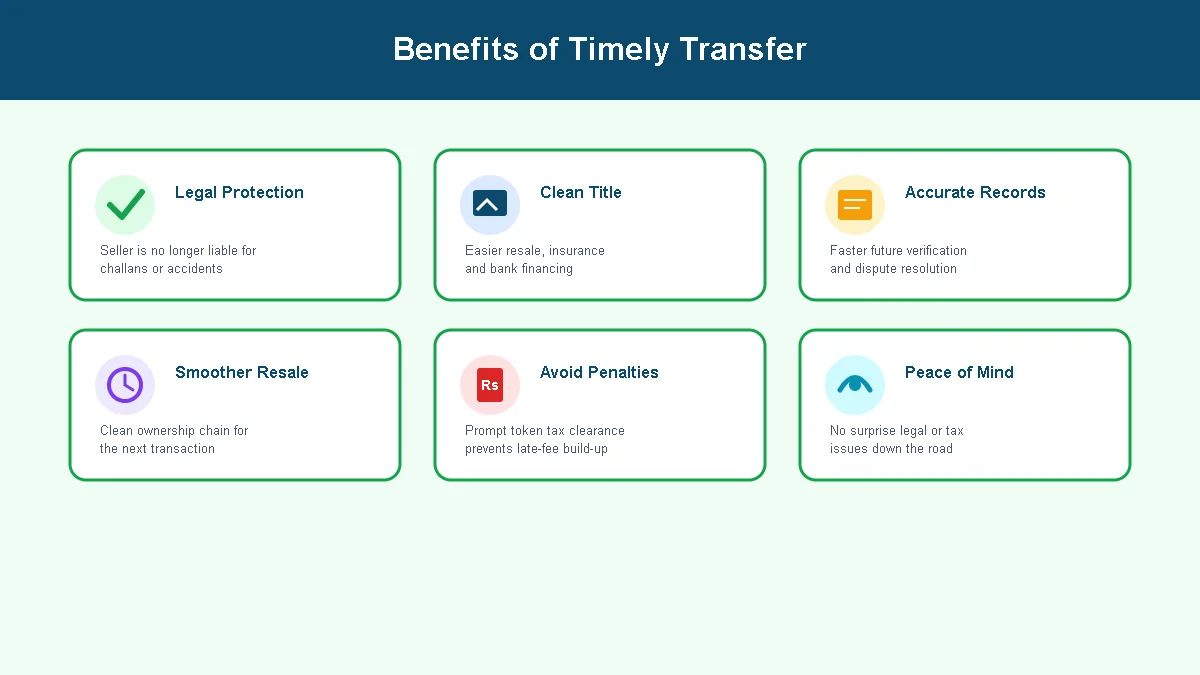
The most common ownership-transfer mistakes in Punjab are delaying the paperwork after a sale, paying “processing fees” to unofficial agents, and starting the transfer before clearing outstanding token tax. Here’s what to watch for:
- Delaying the transfer after a sale. The longer ownership stays in the seller’s name, the harder it becomes to track them down for biometric verification later, and the seller remains exposed to challans in the meantime.
- Assuming a sale receipt is enough. A private sale agreement does not transfer legal ownership on its own — only the Excise Department’s recorded transfer does.
- Skipping the token tax check. Transfer applications generally stall if current-year token tax hasn’t been cleared, so check this before you show up at the office.
- Paying unofficial “agents” extra money to speed things up. Legitimate fees are paid via challan/PSID to the government, not as a cash “service charge” to a middleman promising a faster result.
- Not verifying the vehicle before buying. Confirm registration status, ownership history, and any pending dues using official verification tools before you finalise a purchase — not after.
- Forgetting the buyer’s biometric appointment. Both parties need to appear; a transfer cannot be completed with only the seller present, even if all documents are signed.
- Losing the original registration book/Smart Card. If it’s lost, you’ll need a duplicate first (a separate fee and process) before the transfer can proceed.
Benefits of Timely Transfer
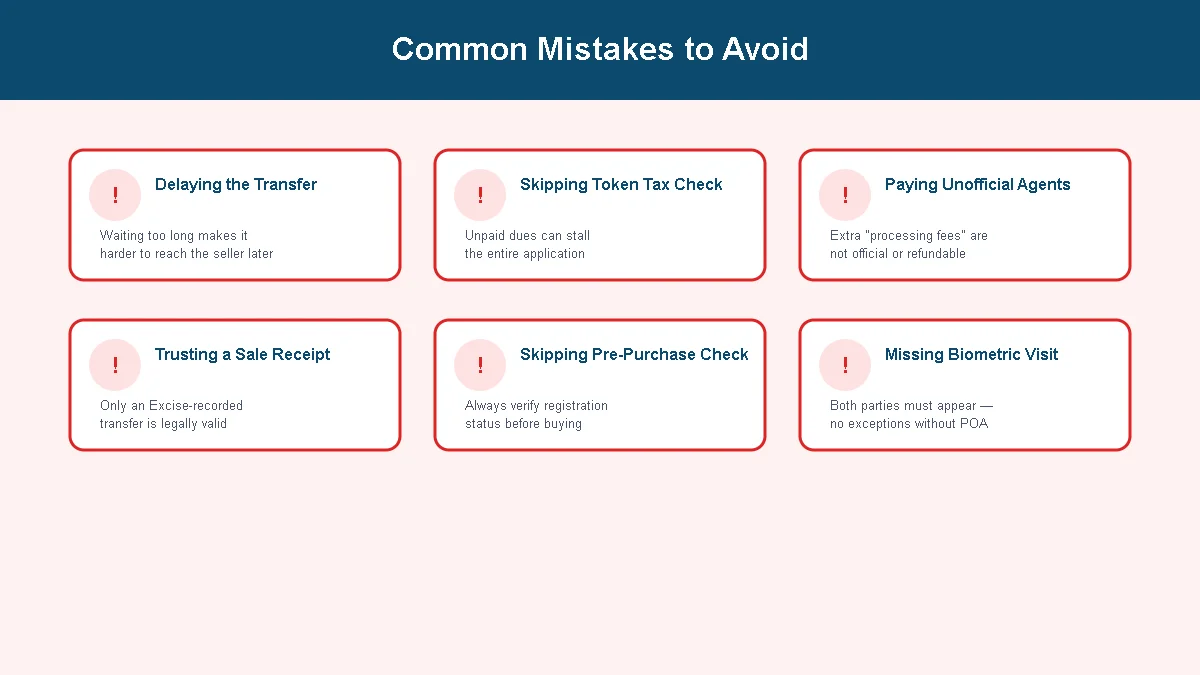
Completing the transfer promptly protects the seller from ongoing legal liability and gives the buyer a clean, verifiable title that supports resale, insurance, and financing. Specifically:
- Legal protection for the seller. Once transferred, challans, accidents, and token tax obligations follow the new owner, not the previous one.
- Clean title for the buyer. A vehicle registered in your own name is far easier to resell, insure, or use as collateral for a loan.
- Accurate government records. This supports faster processing if you ever need duplicate documents, dispute resolution, or ownership verification.
- Smoother future transactions. A documented, up-to-date ownership chain avoids complications if the vehicle changes hands again later.
- Avoiding penalty accumulation. Prompt token tax clearance as part of the transfer process avoids late-payment penalties that grow the longer they’re ignored.
Important Government Guidelines
A few points worth underlining directly from official guidance and department practice:
- Applications for transfer, and payment of related fees, are only accepted through the Excise Department’s official channels — the department’s own portals, or ePay Punjab for online payment.
- Biometric verification of both buyer and seller is a mandatory security measure designed to prevent fraudulent or forged transfers.
- Fees are subject to revision by official notification, so the amounts in this guide should be treated as the currently published baseline, confirmed against the Sialkot district Excise service-fee schedule, rather than a permanently fixed number.
- We found unverified online claims describing a “2026 relief scheme” that supposedly waives transfer fees entirely for a limited period. This claim did not appear on any official Excise Department page or notification we could locate. Do not assume a fee waiver applies to your transfer unless you can confirm it directly with your district Excise office or on an official government portal.
- Never pay transfer-related charges to anyone other than the government, through official challan/PSID channels. Cash “processing fees” paid to unofficial agents are not receipted, refundable, or traceable if something goes wrong.
Bike vs Car Transfer: Quick Comparison
| Factor | Motorcycle | Car |
|---|---|---|
| Base transfer fee | Flat PKR 150 | PKR 1,200–3,000 by engine capacity |
| Smart Card fee | PKR 530 | PKR 530 |
| Biometric verification | Required for both parties | Required for both parties |
| Officially-listed base charges (transfer fee + Smart Card + Transfer Deed) | PKR 980 | PKR 2,030–3,830 depending on cc |
| Processing complexity | Generally simpler, fewer inspection requirements | May involve additional checks for higher-value vehicles |
Offline vs Online Process: Quick Comparison
| Factor | Offline (In-Person) | Online (ePay Punjab) |
|---|---|---|
| Fee payment | Pay at office counter | Generate PSID, pay via bank/app/ATM |
| Document submission | Physical, at counter | Still typically required in person for verification |
| Biometric verification | In person, mandatory | In person, mandatory (cannot be done online) |
| Convenience | Requires office visit for payment too | Saves a separate trip just to pay |
| Best suited for | Those without digital banking access | Those comfortable paying online before visiting the office |
Frequently Asked Questions
What is the vehicle transfer fee in Punjab for 2026?
Based on the Excise Department’s published service-fee schedule, the base transfer fee is PKR 150 for motorcycles and PKR 1,200 to PKR 3,000 for cars depending on engine capacity, plus PKR 530 for the Smart Card and PKR 300 for the Transfer Deed. Please verify the latest applicable fee from the Punjab Excise, Taxation & Narcotics Control Department, as charges may change, and always confirm the exact challan amount before paying.
How much does it cost to transfer a car in Punjab?
The base car transfer fee ranges from PKR 1,200 (up to 1000cc) to PKR 3,000 (above 1800cc), plus the Smart Card fee, Transfer Deed charge, and any outstanding token tax, all billed on the same challan.
How much does it cost to transfer a bike in Punjab?
Motorcycle and scooter transfers carry a flat PKR 150 base fee regardless of engine capacity, plus the standard Smart Card and Transfer Deed charges.
What documents are required for ownership transfer in Punjab?
You need the original registration book or Smart Card, attested CNIC copies of both buyer and seller, a signed Transfer Deed (T.O. Form), and proof that current-year token tax is cleared. Both parties must also complete biometric verification in person.
Is the vehicle transfer fee waived in 2026?
We found no official Excise Department notification confirming a fee waiver, despite this claim appearing on some unofficial websites. Do not assume any waiver applies to your transfer without confirming directly with your district Excise office.
Can I transfer vehicle ownership online in Punjab?
You can pay the transfer fee online through ePay Punjab by generating a PSID, but biometric verification of both buyer and seller must still happen in person at the district Excise office. There is currently no fully online, verification-free transfer process.
How long does vehicle transfer take in Punjab?
Processing commonly takes a few weeks from submission to a new Smart Card being ready, though this is not an officially guaranteed timeframe and can vary by district office workload and document completeness.
Do both buyer and seller need to be present for transfer?
Yes. Biometric verification requires both parties to appear in person, unless one party is represented through a properly registered power of attorney.
What happens if I don’t transfer the vehicle after buying it?
The vehicle legally remains registered to the seller, meaning challans, token tax notices, and even accident-related legal issues can still be directed at the seller’s name, while the buyer has no formally recognised title to the vehicle.
Where can I verify a vehicle’s transfer or registration status?
You can check basic registration details through the Excise Department’s online verification tool, or use MTMIS Punjab’s own vehicle verification resources, including our guides on number plate checks and smart card status, for a quick reference before you commit to a purchase.
Conclusion
Vehicle ownership transfer in Punjab is not complicated once you know the actual numbers — a flat PKR 150 for bikes, PKR 1,200 to PKR 3,000 for cars by engine capacity, plus the standard Smart Card and Transfer Deed charges. The bigger risk is not the fee itself, but delaying the process, trusting unofficial “agents,” or acting on unverified claims about waived fees circulating online. Clear your token tax, gather the right documents, generate your challan through ePay Punjab, and show up together for biometric verification. If you’re navigating other Punjab vehicle services alongside this, our guides on token tax, MTMIS Lahore, and the e-Punjab digital services ecosystem — including the CM Punjab E-Bike Scheme 2026 for anyone considering an electric bike purchase — cover the related processes you’re likely to run into next.
Have you completed a vehicle transfer in Punjab recently? If your district office charged something different from what’s listed here, we’d genuinely like to know — accurate, current information only stays accurate if readers help keep it that way.
Editorial Note
Last Verified: 28 July 2026
Fact Checked: Yes — every fee figure in this article was re-checked against the Punjab Excise & Taxation Department’s published service-fee schedule immediately before publication, and no unofficial or clone-website fee tables were used as a source.
Editorial Note: MTMIS Punjab is an independent, unofficial information resource and is not affiliated with the Government of Punjab or the Excise & Taxation Department. This guide is reviewed and updated whenever the Punjab Excise, Taxation & Narcotics Control Department revises its official fee schedule or issues a new notification affecting these figures. Fees and procedures can change by official notification at any time; please verify the latest applicable fee from the Punjab Excise, Taxation & Narcotics Control Department before making a payment.
Sources Consulted
Official Government Sources
- Punjab Excise, Taxation and Narcotics Control Department — official service-fee schedule (district Excise office publication)
- Punjab Information Technology Board (PITB) — e-Pay Punjab vehicle transfer fee payment announcement
- excise.punjab.gov.pk — departmental portal and vehicle verification service
Independent Cross-Reference Sources
- Multiple independent vehicle-services guides were reviewed for consistency; figures that could not be corroborated against official department sources (including a claimed 2026 fee waiver) were excluded rather than repeated as fact
This article will be reviewed and updated if the Punjab Excise & Taxation Department publishes a revised fee notification.
Official References
- Punjab Excise, Taxation & Narcotics Control Department
- Rates of Transfer Fee — Official District Excise Office (Sialkot)
Last Verified: 28 July 2026
Update History
28 July 2026
- ✓ Verified official transfer fee schedule.
- ✓ Updated Smart Card fee.
- ✓ Removed unconfirmed biometric fee.
- ✓ Added latest Editorial Note.